Friday, March 22, 2013

Part of Whose World?

Okay, this is an essay about a film on a blog about theme parks. Cut me some slack.

Like, seventeen of my degrees are in Film, Disney runs theme parks, the Little Mermaid has been adapted into oodles of attractions in Disney's theme parks, I completed an essay about the Little Mermaid today, and I haven't completed an essay about theme parks in ages. Plus, I'm giddy about this insight, and I wanna tell someone other than my family and girlfriend.

Care to hear?

Monday, June 18, 2012

The purpose of art.

We are weird.

You can’t blame us. We grew up in the Universe—a physical place with nearly nothing physical in it, and no physical boundaries to contain what little there is. It’s a sanctuary for life and love, whose doors are also open to death and suffering. It is interwoven with equal amounts of meaning and futility.

In short, the Universe is no place for small children. Unfortunately, it’s our home, and although we’ve tried our best, it was only a matter of time before we started acting out.

In a Short History of Nearly Everything, Bill Bryson observes some of the mixed messages we’ve learned from our upbringing.

“We don’t know which arrived first, a world that contained [Sir Isaac Newton’s] Principia or one that had no dodos, but we do know that they happened at more or less the same time. You would be hard pressed, I would submit, to find a better pairing of occurrences to illustrate the divine and felonious nature of the human being—a species of organism that is capable of unpicking the deepest secrets of the heavens while at the same time pounding into extinction, for no purpose at all, a creature that never did any of us any harm and wasn’t even remotely capable of understanding what we were doing to it as we did it.”

Like I said, we’re weird. And we're narcissistic. And that is why we have art.

Sunday, June 17, 2012

We rushed into this blog.

Hey, you.

Let's be honest. We enjoy theme parks, and we're fascinated by narratology, and we love one another. That will never change.

If I was Excalibur, I'd deem you worthy.

But we don't know each other. Not really. If we’re gonna advance theme park theory—and there’s no one I’d rather advance theme park theory with—we’ve gotta get on the same page.

So let's bond. I'll start with an essay or two. Nothing complicated, just some trifles you oughta know about me.

You can respond however you like. Then we'll pick up where we left off.

There be squalls ahead, but we'll rough 'em together.

Saturday, January 21, 2012

The EPCOT.

EPCOT is an acronym. It stands for "Experimental Prototype Community of Tomorrow."

Left alone, the phrase sounds like a Russian maguffin.

“Comrades, proceed to Experimental Prototype Community of Tomorrow!”

Perhaps this is a quibble, but it's easily fixed, and the solution could affect a lot of positive change.

Tuesday, December 27, 2011

What is Disneyland's theme?

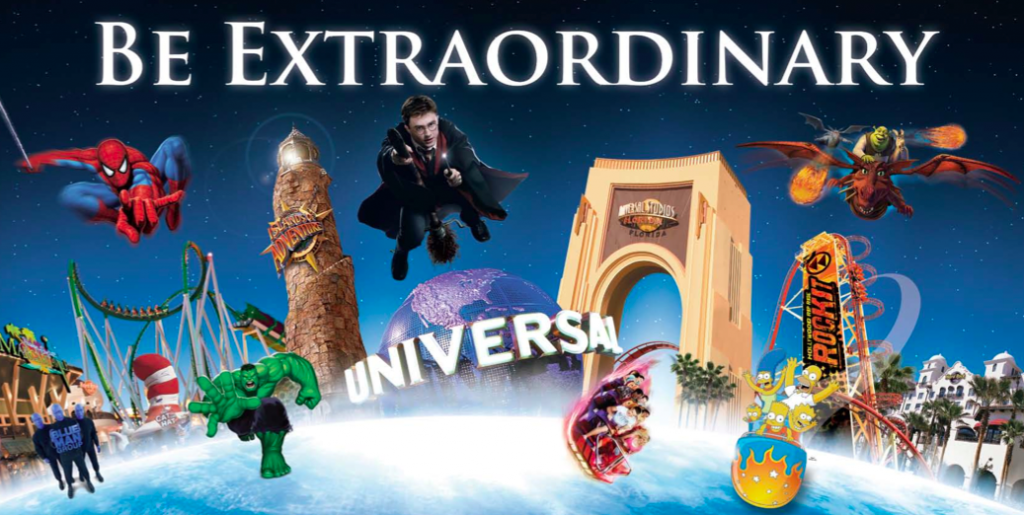
Islands of Adventure is one of the most popular theme parks in the world. It has lands devoted to Dr. Seuss, high fantasy, Harry Potter, Jurassic Park, cartoons produced by Jay Ward, and Marvel Comics. What do these themes have in common?

Um. They all have lands in Islands of Adventure...?

Universal claims that the park’s theme is “places to adventure.” At best, that means, “places to walk around and go on roller coasters." At worst, it means, “whatever Universal can get the rights to.”

Nothing says "extraordinary" like mass-marketed franchises!

Without a theme to unify its lands, Islands of Adventure is not a theme park, but a themes park--or, more pedantically, "an amusement park with themed lands." That’s no great loss, because it’s still a lotta fun, and it doesn’t have much integrity to lose. It’s not like we're talking about Disneyland, here.

Say, while we’re on the subject, what’s Disneyland’s theme?

Uh oh.

Nothing’s coming to mind. Animal Kingdom's theme is “animals,” EPCOT is “a permanent World’s Fair,” Hollywood and Universal Studios are both “movies,” but Disneyland? I dunno.

How dispiriting!

Disneyland is definitive. When you hear the phrase “theme park,” you probably think of the castle. It’s so iconic, they’ve cloned it five times, on three different continents.

A mouse made the company, but he isn't its logo.

Surely the quintessential theme park is, indeed, a theme park, and not “an amusement park with themed lands!” Surely there’s a subject that unifies it!

...right?

Thursday, October 27, 2011

Pardon our dust!

I'm applying to PhD programs, and it's gobbling up my time.

Fear not! There's plenty of forthcoming content. To whet your whistle:


There are four ride-throughs in the works.

Two dark rides for Beastly Kingdom: one about a dragon, and one about sirens.

A show for Hollywood Studios about directing.

A re-imagined Twenty Thousand Leagues Under the Sea submarine ride for Tomorrowland.


There are also new ideas, causes, and philosophies gestating.

Figuring out what Disneyland's theme is, exactly.

Developing a new land for Disneyland.

The problem with--and solution for--Tomorrowland.

What to do with toddlers in the parks, and how we can broaden attractions to include them without excluding everyone else.

Why there hasn't been a great Brobdingnagian attraction.


Stay tuned!

Saturday, September 17, 2011

Animal Kingdom needs a dark ride.

For years, Animal Kingdom’s advertisements insisted that it was “not a zoo.”

Nahtazu, n., A theme park infested with zoo animals.

The advertisers were so proud of what the park wasn’t, they forgot to tell us what it was. Not that their summary would matter. They were wrong.

It is a zoo. And it’s a magnificent zoo. The animals are glorious, and the theming is some of Disney’s most tasteful work. Animal Kingdom has nothing to be ashamed of.

...except its attractions. If I were advertising a park whose E-tickets are a raft ride about deforestation and a movie where a stinkbug farts on us, I’d insist that it is only a zoo.

We need more attractions.

Expedition Everest was a helpful addition, but it’s a thrill ride. If we meet the height requirement, a yeti tries to eat us. If we don’t meet the height requirement, a yeti tries to orphan us.

"Hi, kids! I'm adopting you! My stool smells like your birth parents!"

We need attractions for all ages. If possible, they should be dark rides, partly because dark rides are a Disney speciality, but mostly because they’re air conditioned.


Let’s work backwards. If we scrutinize Animal Kingdom's lands, maybe we can find a subject they haven't explored yet.

Thursday, September 8, 2011

How to adapt a movie into a ride.

A lot of movies would make great rides, but we have to be careful.

If we faithfully translate a movie into a ride, it’ll be redundant. We’ll spend the whole ride remembering the movie, instead of being immersed in the movie.

It would be like if we went to a concert, hoping to hear this...


...but instead of hearing this...


...we heard this.


A ride that’s based on a movie must provide new insight into a familiar story.

It should use our foreknowledge as a shortcut. Since we already know the story, the ride doesn’t have to waste time explaining it. Instead, it should make us experience the movie from a different perspective.

That’s not an easy thing to do. There are two common mistakes, and there are two effective approaches.

Wednesday, August 31, 2011

A dark ride for Dinoland!

Dinoland, USA seems like a natural location for a dark ride, since its animals must be animatronic. (Real dinosaurs are represented by such a demanding union that it’s not worth hiring them.)

The difficulty is making a dinosaur dark ride that appeals to all ages.


At the end of the day, I'd prefer this to a stinkbug farting on me.

We have to establish a tone that’s awesome, without being too scary. We’ll start by figuring out the setting.

I have a theory about the relationship between settings and dark rides, but I’ll discuss it in-depth in a later article. For now, let me over-simplify: dark rides can be (1) stylized, (2) set indoors, or (3) set outdoors, but during the night.

Saturday, August 20, 2011

The Hollywood Studios that never was, and always will be.

I love Hollywood Studios.

I’ve graduated from, like, ninety-seven universities, but I have more pride in a theme park. Honestly, it’s my alma mater.


Working at the Backlot Tour changed my life. My writing flourished, and my filmmaking matured. I met some of my best friends, hid from my troubles, fell in love, began my quarter-life crisis, and made a Difference.

I stood beneath the Earful Tower as they removed the Disney-MGM Studios logo. I returned when they painted the Hollywood Studios logo.

And it needs to be razed.

The whole park. It’s lousy. It started lousy, it’s getting lousier, and the future holds no signs of delousing.

Its theme is lazily defined and lazily maintained. Its layout is tortuous. Half of the attractions are irrelevant, and the other half are poorly conceived.

Nothing in Disney brings out my Daddy Issues as much as Studios. Somewhere in there, there’s a great park...a park I’m proud to have in my ancestry...but I take every lousy aspect as a personal offense.

So please excuse the tone of this article. It’s a little severe in places, but that’s only because I care.

Rest assured, that passion will be reflected in forthcoming articles on how I intend to improve Studios. The stuff I’m about to introduce may be the most exciting work you’ll see on this blog.

So let’s give Studios a bath, remove its glasses, let down its hair, and teach it to enunciate its haitches.


Why can't Studios be more like a park?
Parks are so tasteful, yet bursting with flair,
painstakingly themed, but to us,
laissez-faire!
They excite and delight each parent, teen, and brat!
Why can't Studios be like that?